
R B Hedges
Author of the "Story of the People" series
About the Author
R B Hedges crafts character-driven fiction that lingers long after the last page. Blending vivid settings with emotional depth, R B Hedges brings the Story of the People, an advanced ancient coastal society threatened by rising sea levels at the end of the last Ice Age, to life in a series of books. When not writing, R B Hedges is usually reading, researching his next novel, or editing his current manuscript.
Story of the People
At the close of the last Ice Age, an advanced coastal society faces the relentless rise of the seas. Through the eyes of explorers, artisans, and storytellers, the series follows the People as they confront change, conflict, and the choice to seek higher ground.
Land of the People
 We often think of a coastline as a line on a map that is fixed in both time and space, much the same as a range of mountains or a string of islands. While that is generally a reasonable assumption within the lifespan of a single individual, it is an oversimplification with regard to the peopling of the earth. The most recent Ice Age reached its maximum extent between 20,000 and 26,000 years ago. So much water was tied up in the ice sheets, reaching several miles in thickness, that global sea levels were about 410 feet lower than they are today. The lowered sea levels resulted in coastlines that extended scores of miles seaward beyond our present-day coasts exposing millions of acres of land now submerged beneath the seas.
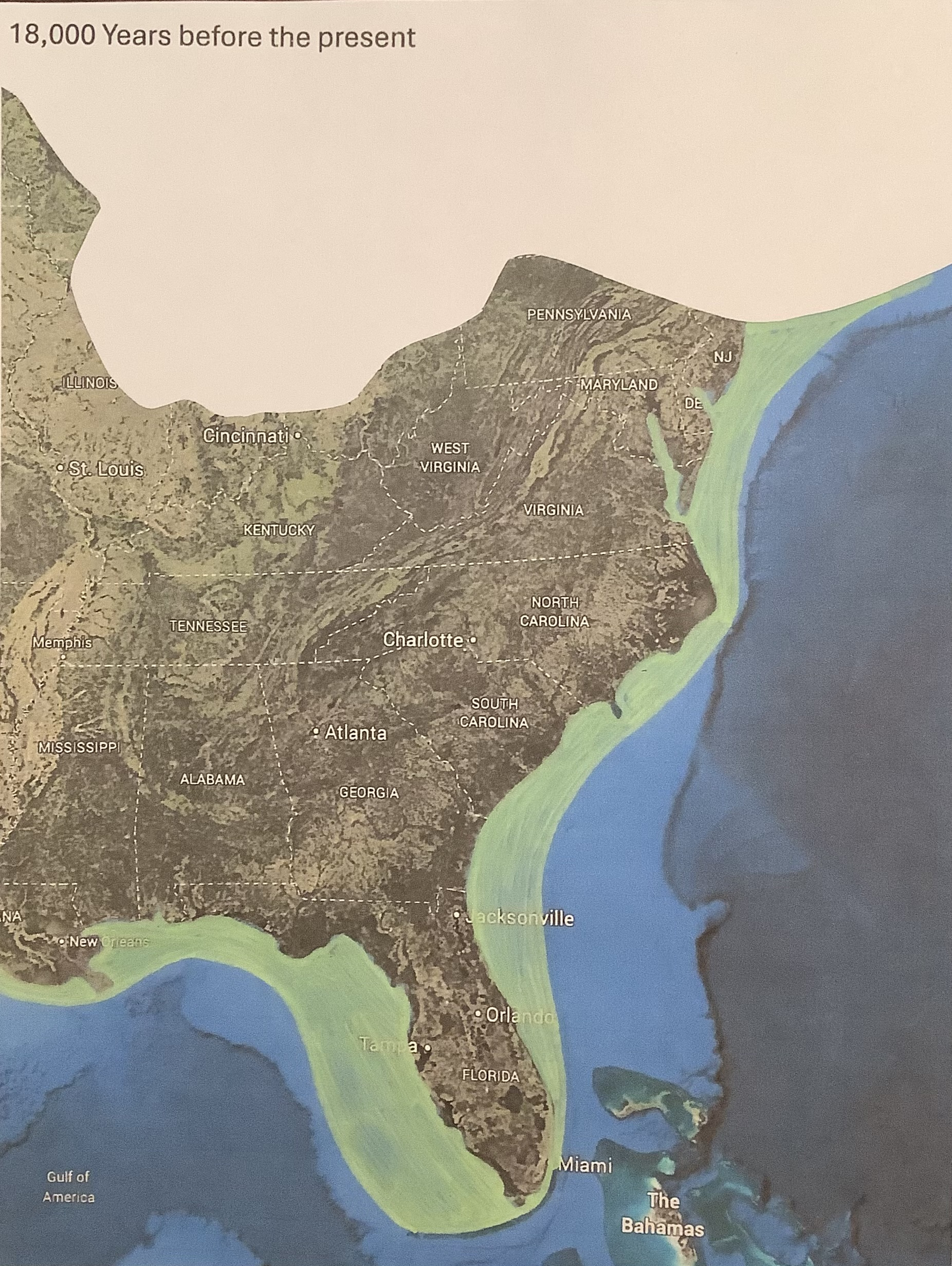 If we look back in time 18,000 years ago, when the ice sheets first started melting, we see a whole different world. The Laurentide ice sheet, with a thickness of about 2 miles, covered much of the northern United States. The shoreline (depicted in green), resultant from the lowered sea levels, extended far beyond our current coastline and the exposed land most likely consisting of rolling lowlands with numerous meandering streams disected by extensions of today’s major rivers.
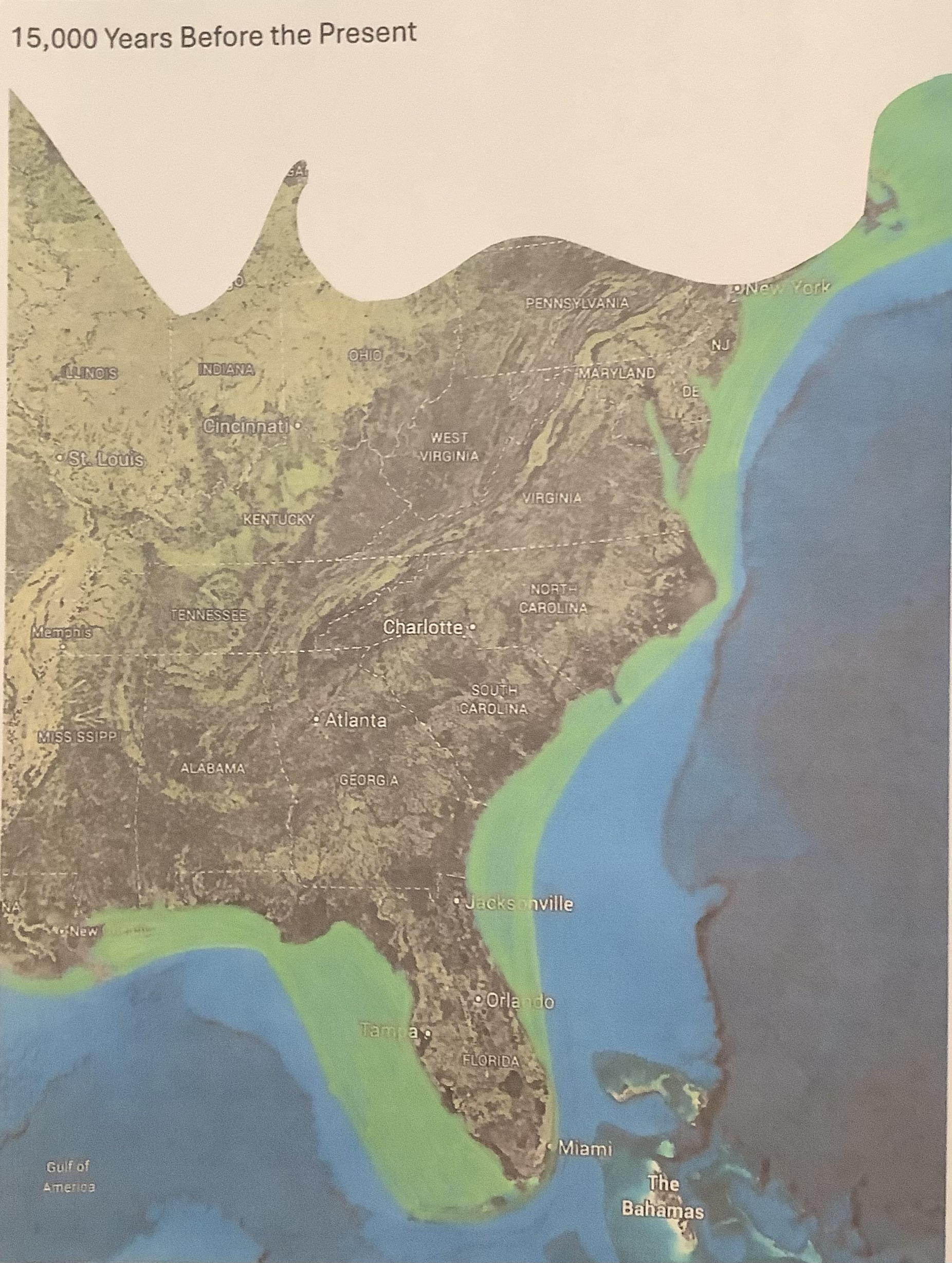 As the ice sheet melted, the sea levels rose, flooding lowland areas and moving the coastline inland. By about 15,000 years ago, the continued melting of the ice sheet resulted in the gradual retreat of the face of the sheet northward. Sea levels, as a consequence of the melting, had gradually risen about 50 feet from the 410 foot low during the glacial maximum period to about 360 feet below current sealevels. As a result, the exposed coastal lands began to shrink in area as the seas moved inland.
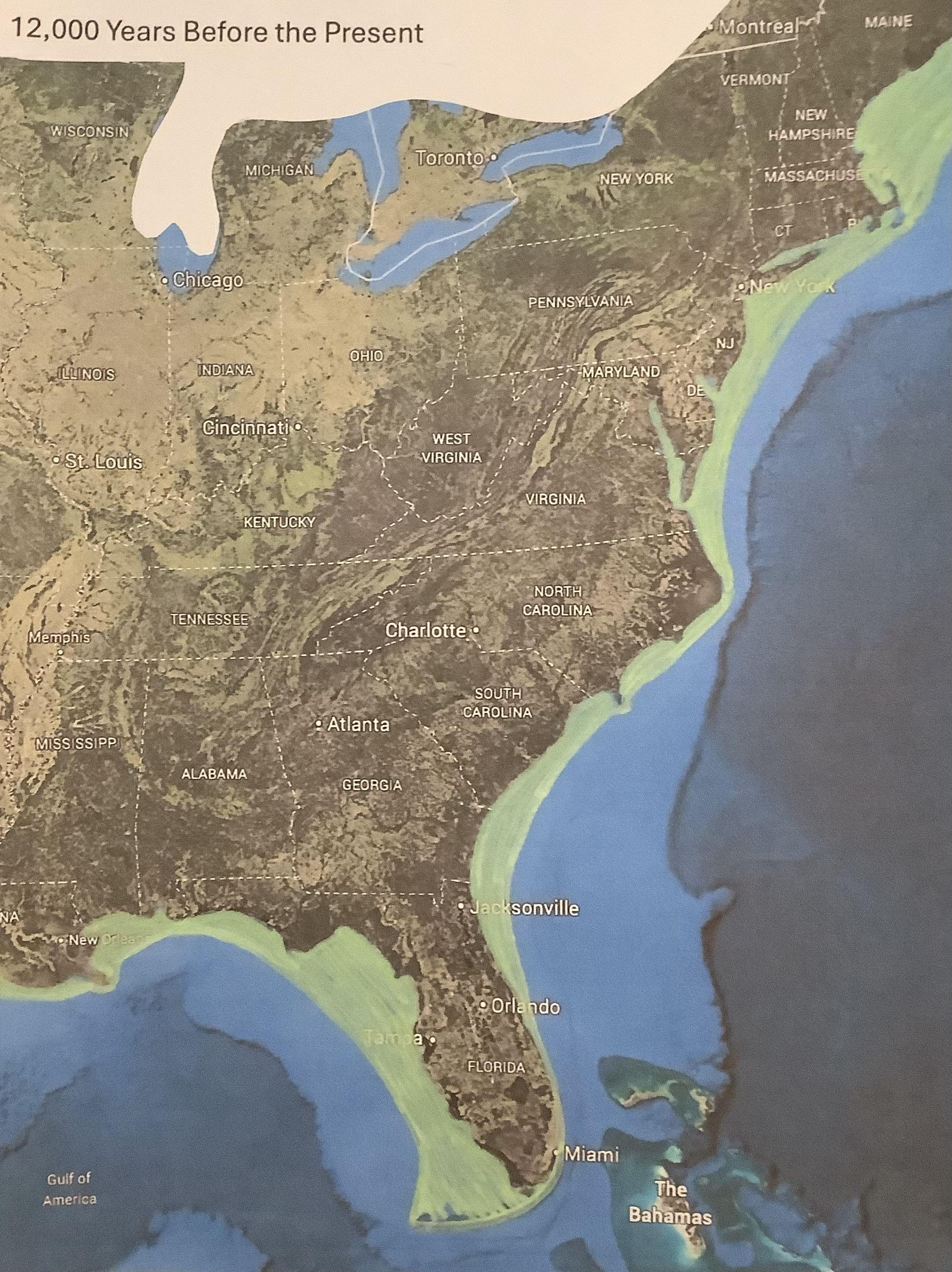 The ice sheet continued to melt, experiencing a ‘meltwater pulse’ (referred to as MWP1a) between 13,500 and 14,700 during which global sea levels rapidly rose approximately 70 feet. By about 12,000 years ago, with continued melting, the ice sheet had retreated northward of most of the Great Lakes except for Lake Superior and the northern portion of Lake Michigan. Sea levels, as a result of both gradual melting and the meltwater pulse, had risen to about 200 feet below current sealevels. As a result, the exposed coastal lands continued to shrink in area and the seas moved further inland.
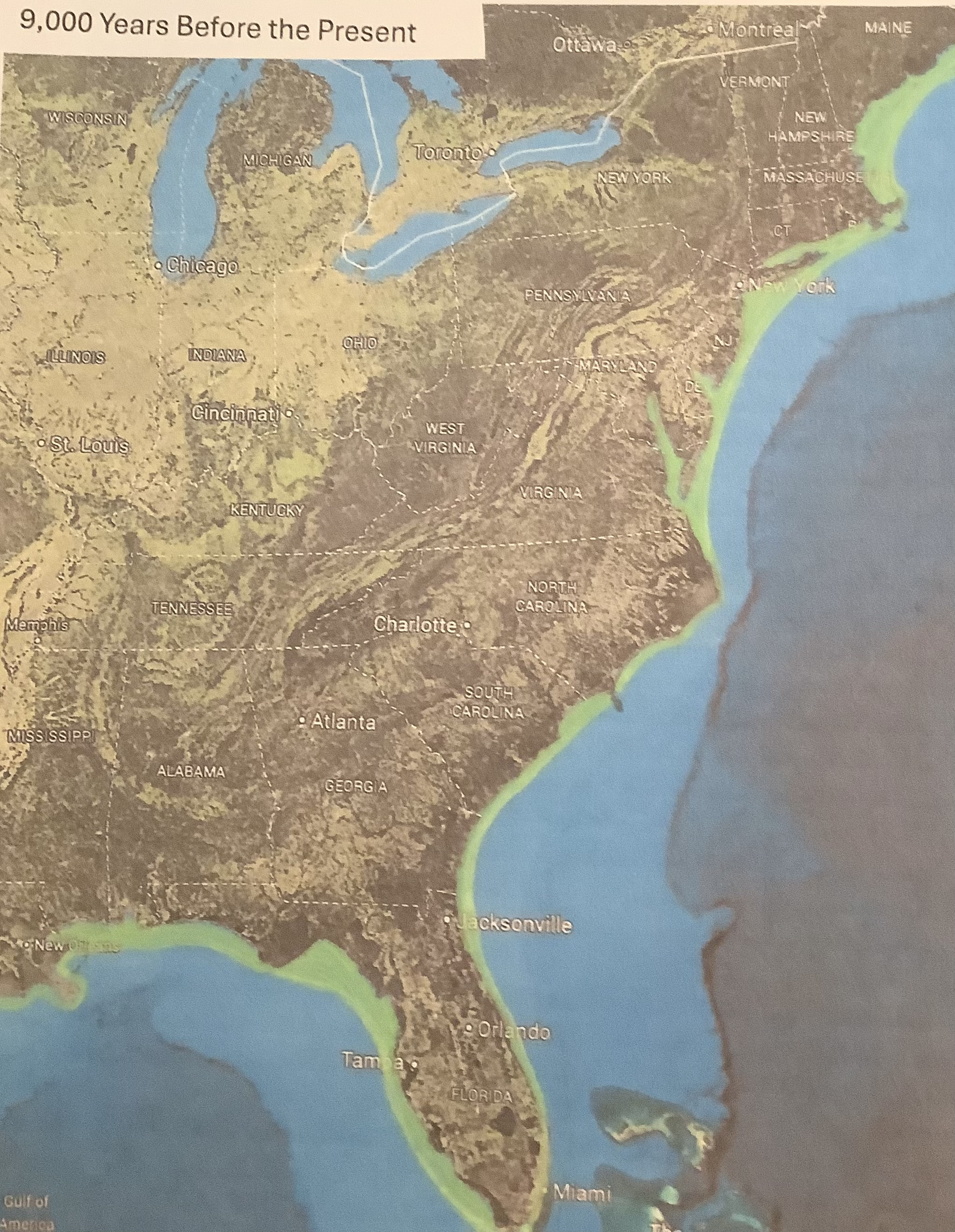 Melting slowed to a near halt during an abrupt cooling period known as the Younger Dryas period which ended about 11,700 years ago whereupon gradual melting resumed. This melting accellerated during another meltwater pulse (referred to as MWP1b) which occurred between 11,200 and 11,500 years ago. This pulse resulted in a sea level rise of as much as 90 feet. By 9,000 years ago, the ice sheet had retreated northward beyond the continental United States with remnants remaining in Canada and Greenland. As a result of this combined melting, sea levels had risen to within about 100 feet below current sealevels. The exposed coastal lands continued to shrink in area and the seas moved further inland.
By 6,000 years ago, the continental ice sheets had vanished and sea levels had risen to near current levels. Previously exposed coastal plains were submerged beneath the waves and, with them, all evidence of any previous habitation by man or beast.
Books

The Great White (Story of the People, Book I) August 2026
At the end of the Ice Age, a coastal society is driven inland by rising seas while hunter/gatherer clans are forced to expand their hunting grounds seaward by the increasingly scarce megafauna near the retreating ice sheet, known as the Great White. This is the character-driven tale of the inevitable conflict between two vastly different cultures and the young woman caught up in it.

The Story Teller (Story of the People, Book 2) Tentatively October 2026
The conflict between the People and the Clans has ended but conflict within the People has continued. The Strict Adherents are determined to halt the migration away from the rising seas. Their attempts are hindered by the Storyteller's tales of his encounter with the Lost Tribe of the People whose very existance proves the Land of the People extends well beyond the seas. This is the tale of the of the Strict Adherents' attempts to bind the People to the coast and the People's desire to move to higher grounds.

The Lost Tribe (Story of the People, Book 3) 2027
The conflict between the People and the Clans ended generations ago. Tales of things that had occurred during that conflict have been passed down to subsequent generations by the Storyteller. One such recollection was the Storyteller’s encounter with the Lost Tribe. This is the tale of the Explorers search for the Lost Tribe and the dangers they encounter along the way.
The Plague (Story of the People, Book 4) 2027
Following the return of the Explorers, a mysterious plague engulfs the world of the People, affecting both man and beast. This is the story of the internal conflicts that arise as a result and the ultimate “solution”.
